Showing posts with label Old Books. Show all posts

Tuesday, May 19, 2009

New Books and Old Books, from Steyn to Chesterton

Consistent with the oft-repeated axiom from C.S. Lewis that the reading of new books should be punctuated with the reading of old books in order to avoid the temptation to "chronological snobbery," two books, one in each category, have ruled the reading corner of late.

The first, a relatively new one, America Alone by Mark Steyn (2005?)(been trying to get this one into my queue for a while) is a wakeup call to post-Christian America and the post-Christian church. With Europe as the model, we are offered a step-by-step analysis of the trends weakening us and the cultural suicide of the world as we know it on both sides of the pond. Some quotables...

On the false promise of secularism:
The meek's prospects of inheriting the earth are considerably diminished in a post-Christian society....[quoting Kathy Shaidle] It is secularism itself which is part of the problem, not the solution, since secularism is precisely what created the European spiritual and moral vacuum into which Islamism has rushed headlong.
On the paralyzing effect of European (now American) Socialism:
The trouble with the social democratic state is that when government does too much, nobody else does much of anything.
On the destructiveness of multiculturalism:
But if you think you genuinely believe that suttee [the Indian cultural practice of burning of the living widow along with the deceased husband] is just an example of the rich tapestry of indigenous cultures, you ought to consider what your pleasant suburb would be like if 25, 48% of the people really believed in it too. Multiculturalism was conceived by the Western elites not to celebrate all cultures but to deny their own; it is, thus, the real suicide bomb.
And there is much more, some of it quite entertaining despite the ominous topic. Which brings me to book two, much older, but in a similar vein and as timely as a stimulus package or an auto industry takeover. At Twin Cities Chesterton Society meetings, we've been reading and discussing the outstanding (large) biography of GKC by Maisie Ward (1942). Gilbert Keith Chesterton is a treasure chest of not just his story, but his vision of the world. A major component consists of early unpublished writing, correspondence and quotations. Enormously clever and joyful on many topics and many levels, GKC watched, wrote, waved his sword/walking stick in the air and cried out against England's initial embrace of precisely what we are now embracing—the diminution of religion, tradition and liberty, and the incremental arrival of the the Servile State. A couple of quotes:
We do not want, as the newspapers say, a church that will move with the world. We want one that will move the world. We want one that will move it away from many of the things towards which it is now moving; for instance, the Servile State. It is by that test that history will really judge, of any church, whether it is the real Church or no. —GKC
[Chesterton]...did not think, then or ever, that any increase of comfort or security was a sufficient good to be bought at the price of liberty. —Maisie Ward

Tuesday, February 24, 2009


The Amazon Kindle
Some of us in the book-related business have been pondering for some time our future as designers and purveyors of the traditional paper variety. For me, the simultaneously threatening and intriguing front-runner has been the Kindle; an ebook reader that today arrives in its second iteration. Here's a simultaneously comforting and threatening review in the NYTimes, including this small comfort for book cover designers everywhere:

So, for the thousandth time: is this the end of the printed book?

Don’t be silly.

The Kindle has the usual list of e-book perks: dictionary, text search, bookmarks, clippings, MP3 music playback and six type sizes (baby boomers, arise). No trees die to furnish paper for Kindle books, either.

But as traditionalists always point out, an e-book reader is a delicate piece of electronics. It can be lost, dropped or fried in the tub. You’d have to buy an awful lot of $10 best sellers to recoup the purchase price. If Amazon goes under or abandons the Kindle, you lose your entire library. And you can’t pass on or sell an e-book after you’ve read it.

Monday, December 08, 2008

Old Books and New Ideas

I've added a new label representing a theme I'm fond of, "Old Books." It seems that at almost any given time I've got at least one in the stack by the fireplace that I'm working my way through. Sometimes I buy new editions of old books, but the real prize is always the old edition, as close to the 1st Edition as possible.

My most recent finds in the second category happened at a local library book sale a couple of weeks ago. Big room full of old books, grocery bag full: $5.00. What a deal. So I loaded up an over-sized 1880's 3-volume set of Washington Irving (haven't read anything in them yet, just enjoy looking at them with their beautiful embossing and engraved illustrations), and among a half-dozen others, a copy of E. Stanley Jones The Christ of the Indian Road c. 1925. That one is fascinating in the Theological category and will merit a later post.

A lot of the old books around me right now are, predictably, Chesterton books. Now an official member of the American Chesterton Society, I find my self prepping for the monthly discussion group with whatever piece of his work is on the agenda.

Today's first old book is one of them, and one that led me straight to the second, a truly old classic by Henry James—picked up at some long-forgotten garage or book sale and languishing on my shelf until recently.

1. Tremendous Trifles by G.K. Chesterton 1909

GKC inquirers, start here! This excellent collection (download here) of short articles from the London Illustrated News captures the essence of Chesterton. On the idea of Seeing, particularly the smaller things of the world :
...the object of my school is to show how many extraordinary things even a lazy and ordinary man may see if he can spur himself to the single activity of seeing.
Everything is in an attitude of mind; and at this moment I am in a comfortable attitude. I will sit still and let the marvels and the adventures settle on me like flies. There are plenty of them, I assure you. The world will never starve for want of wonders; but only for want of wonder.
The 39 essays that follow are funny, poignant and off the wall.

One not to miss: The Twelve Men—on how some things are just too important to leave to the experts.

Another: The Red Angel, in wonderful support of reading fairy tales and scary stories to kids. His one exception? My next old book...

2. The Turn of the Screw by Henry James 1898

James was a contemporary of GKC and brother of the "father of pragmatism," philosopher William James, a quirky fellow in his own right. Chesterton summarized Henry's effort:
It describes two innocent children gradually growing at once omniscient and half-witted under the influence of the foul ghosts of a groom and a governess. As I say, I doubt whether Mr. Henry James ought to have published it (no, it is not indecent, do not buy it; it is a spiritual matter)...
So, of course I had to read it. It's terrible. Not all old books are good books. My complaint is not about ghostliness, or preternatural terror, but that the author lead me on only to abandon me at the end. The reader feels the evil atmosphere but is left wondering: Were the horrors real or only in the mind of the narrator? Was the evil in the perceiving or that which was perceived? That may have been James' intent, and perhaps even his genius, I don't know. Like so much modern story-telling and unlike good fairy tales and good stories of terror, it ends without resolution or moral point of view. That's the reason, I suppose, for Chesterton's warning that it was a "spiritual matter."

On the plus side, my old-old copy is mint condition from the Everyman Library with dust jacket still intact!

Next old book: The Christ of the Indian Road by E. Stanley Jones, and old book with ideas that will appeal to some modern Christians and appall others. It did a little of both to me.

Monday, February 12, 2007

More Gems from J. Gresham Machen

On the weakened, more culturally attractive view of God and man offered by liberal theology then (1923) and it's current incarnation, the "emergent conversation" today—contrasted with the terrible and joyous purity of the Bible's teaching:

"Religion cannot be made joyful simply by looking on the bright side of God. For a one-sided God is not a real God, and it is the real God alone who can satisfy the longing of our soul...."

"...God's own Son delivered up for us all, freedom from the world, sought by philosophers of all the ages, offered now freely to every simple soul, things hidden from the wise and prudent revealed unto babes, the long striving over, the impossible accomplished, sin conquered by mysterious grace, communion at length with the holy God, our Father which art in heaven."

Surely this and this alone is joy. But it is a joy that is akin to fear. It is a fearful thing to fall into the hands of the living God. Were we not safer with a God of our own devising—love and only love, a Father and nothing else, one before whom we could stand in our own merit without fear? He who will may be satisfied with such a God. But we, God help us—sinful as we are, we would see Jehovah. Despairing, hoping, trembling, half-doubting and half-believing, trusting all to Jesus, we venture into the presence of the very God. And in His presence we live."
—Christianity and Liberalism p.134-135

Go Machen!

Sunday, December 17, 2006

Lewis on Chronological Snobbery...

The tendency to assume that an idea or practice represents progress just because it's more recent, and a reading person's remedy:
It’s a good rule after reading a new book never to
allow yourself another new one till you have read an
old one in between. If that is too much for you, you
should at least read one old one to three new ones....
Every age has its own outlook. It is especially good
at seeing certain truths and especially liable to make
certain mistakes. We all therefore need the books that
will correct the characteristic mistakes of our own
period.... None of us can fully escape this blindness,
but we shall certainly increase it, and weaken our
guard against it, if we read only modern books....The
only palliative is to keep the clean sea breeze of the
centuries blowing through our minds and this can
only be done by reading old books."

Check out the C.S. Lewis Institute, a new addition to Really Smart Guys, for lots of good stuff.

Tuesday, December 05, 2006

New from Another Old Book

Just got my used copy of "Christianity and Liberalism" by J. Gresham Machen (1923) in the mail today. This is a man who drew a line in the sand with his generation's version of Emergent doctrinal ambiquity and outright abandonment of the Gospel in the mainline churches. Have to work so can't read 'til later, but cheated and read the last paragraph first:

"Is there no refuge from strife? Is there no place of refreshing where a man can prepare for the battle of life? Is there no place where two or three can gather in Jesus' name, to forget for the moment all those things that divide nation from nation and race from race, to forget human pride, to forget the passions of war, to forget the puzzling problems of industrial strife, and to unite in overflowing gratitude at the foot of the Cross? If there be such a place, then that is the house of God and that the gate of heaven. And from under the threshold of that house will go forth a river that will revive the weary world."

Friday, August 18, 2006

If We Fail to Learn from History...

Here's a little piece of history, described by E.H. Broadbent in his book (oft-quoted on this blog) The Pilgrim Church, Marshall-Pickering 1931, related to the question of what might constitute excessive emphasis on human authority among believers.

"The quest of the Mystics [devout medieval Christians who sought to live personally in authentic New Testament faith, having given up, in a sense, on the Church being reformed—TD] for immediate communion with God, without priestly or other intervention, constantly brought them into conflict with the priests. Suspected of being of this mind, Loyola [Ignatius Loyola b. 1491] was more than once imprisoned by the Inquisition and by the Dominicans, but was always able to show them that he was not what they thought, and to obtain release.

Indeed, though at first so strongly affected by the writings of the Mystics, Loyola evolved a system which was the very contrary of their teaching. Instead of seeking experiences of direct communion with Christ, he placed each member of his Society under the guidance of a man, his confessor, to whom he was pledged to make known the most intimate secrets of his life and to yield implicit obedience. The plan was that of a soldier, each one was subject to the will of one above him, and even the highest was controlled by those appointed to observe evey act and judge every motive.

In the course of years of study and travel, of teaching and charitable activities, during which there were unavailing efforts to get to Jerusalem, and also interviews with the Pope, that company gradually gathered round Loyola, which was organised by him as the 'Company of Jesus' in Paris in 1534. He and six others, including Francis Xavier, took vows of poverty and chastity and of missionary activity, and in 1540 the Pope recognized the 'Society of Jesus', to which the name of 'Jesuit' was first given by Calvin and others, its opponents.

The careful choice and the long and special training of its members, during which they were taught entire submission of their own will to that of their superiors, made of them a weapon by which not only was the Reformation checked, but a 'Counter Reformation' was organized which regained for Rome much that she had lost."

Saturday, May 20, 2006

The Great Divorce

Reading again, this time as a project with my son Tim, one of my favorite of all C.S. Lewis books. It's also one of the shortest, 128 pp. in my edition. Very entertaining story of a bus trip from Hell to the very outskirts of Heaven. Every passenger has been given the opportunity to stay, on certain very simple conditions. Most elect to go back to Hell, though their heavenly greeters try desperately to convince them otherwise.

We get to hear several conversations including the one from which my favorite lines in the book are excerpted—it's between one particularly self-righteous passenger and his greeter, a man he knew and despised in life who now in heaven begs him to stay:

Bus Passenger: "What do you keep on arguing for? I'm only telling you the sort of chap I am. I only want my rights. I'm not asking for anybody's bleeding charity."

Heavenly Greeter: "Then do. At once. Ask for the Bleeding Charity. Everything is here for the asking and nothing can be bought."

Monday, April 03, 2006


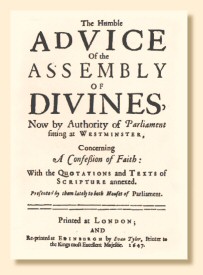
Westminster Confessions
Almost halfway through the book The Pilgrim Church by E.H. Broadbent, Marshall-Pickering 1985, I am now in the early days of the Reformation—Wycliffe, Huss and some lesser known reformers of that era.

The premise of the book is, of course, that there were throughout the centuries, lots of faithful, biblically sound, and growing groups of believers all over the world—without any need for the Reformation as we think of it. Among them were the Waldenses and the Vaudois in Southern Europe, enormous, widespread "unofficial" churches—the latter descended directly from the Apostles' ministry in Rome and continuing through the early days of the Reformation (13-1400s) in spite of terrible persecution from the hierarchy of the Church. The name Evangelic given to them, is tied not insignificantly to our term Evangelical today, referring to Bible-believing, evangelizing churches.

They had little time for the hierarchical, man-centered, power-hungry system that then characterized the Papal Church. Even today's norms of church governance, where whole congregations have ultimate responsibility for the direction of their fellowships, reflect the practices of these churches. Broadbent concludes of the Waldenses, "In matters of discipline, appointment of elders, and other acts, the whole church took part, in conjunction with its elders." All this long before any notions of political democracy had taken hold in medieval Europe.

It is fascinating and so encouraging for me just to get a little familiar with what God has been doing with his church in big and small ways in the nooks and crannies of history. Their faithful approach to truths like the priesthood of the believer, salvation by faith, Christ's headship of the Church and the significance and role of His body, the members of the church, were consistent with, and apparently influenced men like John Huss and the early Reformers, who stood up against the corrupted Church of Rome. They were aggressive in spreading the Gospel but were known for their peaceable lives and kindness to the poor and the sick.

The Westminster Confession, shows up a little later (1648). It was "...commissioned from an assembly of 121 Puritan clergymen meeting in Westminster Abbey, called the Westminster Assembly , which was convened in 1643 for the purpose of drafting official documents for the reformation of the Church of England." (from an introduction) It seems to be these good men's attempt, in the wake of recovery from Rome's corruptions, to answer the question "What is Biblical Christianity...and What is the Church?"

Quaint style and language to us, but probably some of the most complete thinking on the church and the essential truths of the Bible I'll ever encounter outside the Bible itself. The Savoy Declaration was added in 1658 with some clarifications and new references to the church and church order that have provided a foundation for many, if not most, modern churches. Developing...

Friday, March 31, 2006

A.W. Tozer on Unity
"Someone may fear that we are magnifying private religion out of all proportion, that the "us" of the New Testament is being displaced by a selfish "I." Has it ever occurred to you that one hundred pianos all tuned to the same fork are automatically tuned to each other? They are of one accord by being tuned, not to each other, but to another standard to which each one must individually bow. So one hundred worshippers met together, each one looking away to Christ, are in heart nearer to each other than they could possibly be were they to become "unity" conscious and turn their eyes away from God to strive for closer fellowship."


From Chapter 7 "The Gaze of the Soul" in The Pursuit of God by A.W. Tozer

Thursday, March 30, 2006

On Love that is Christian
A wonderful Lewis quote from a recording of The Four Loves radio broadcast series, more or less the same as in his book with that title.

"Such, I conceive, is the world of agape. A world of unbounded giving and unchained receiving. Where all blessed creatures need, and know that they need, nothing but God, and are therefore set free to love one another disinterestedly. And so your love shall be like His; born neither of your need or of my deserving, but of plain bounty. I think those are drawing near to heaven, who, in this life, find that they need men less and love men more, and delight more in being loved without being needed. For where agape is, there is in some degree, heaven."

Thursday, March 23, 2006

Having been a long time fan of C.S. Lewis, it occurred to me at some point that it would be interesting to try some authors that he read, and who influenced his way of thinking. In his autobiography SURPRISED BY JOY, I think, he mentions some of them: George MacDonald, GK Chesterton and others, and in other places he speaks highly of the novels by fellow Inkling Charles Williams.

I have yet to dive into MacDonald, whose PHANTASTES Lewis says changed his way of thinking in dramatic ways. Chesterton is wonderful, though challenging. ORTHODOXY is worth coming back to again and again...you'd think he's writing in the early part of the 21st century, not the 1910's and 20's. Where I really need help is with Charles Williams.

Reading and hearing so many good things about Williams novels, I've tried three: ALL HALLOW'S EVE, THE PLACE OF THE LION, AND DESCENT INTO HELL. I must admit I don't really get them. There are some intriguing ideas and plot lines that keep you going, but mostly I feel like I haven't broken the code, or maybe he's just over my head.

I just finished DESCENT INTO HELL and would love to hear what other readers think of it. Stanhope's taking on the suffering and anxiety of another character expands the idea of "bear one another's burdens and thus fulfill the law of Christ" and that theme I could follow, but little else, to be truthful. Somebody enlighten me!